What Does the Latest AI News Mean for Grok Bot, ChatGPT and Claude Users?
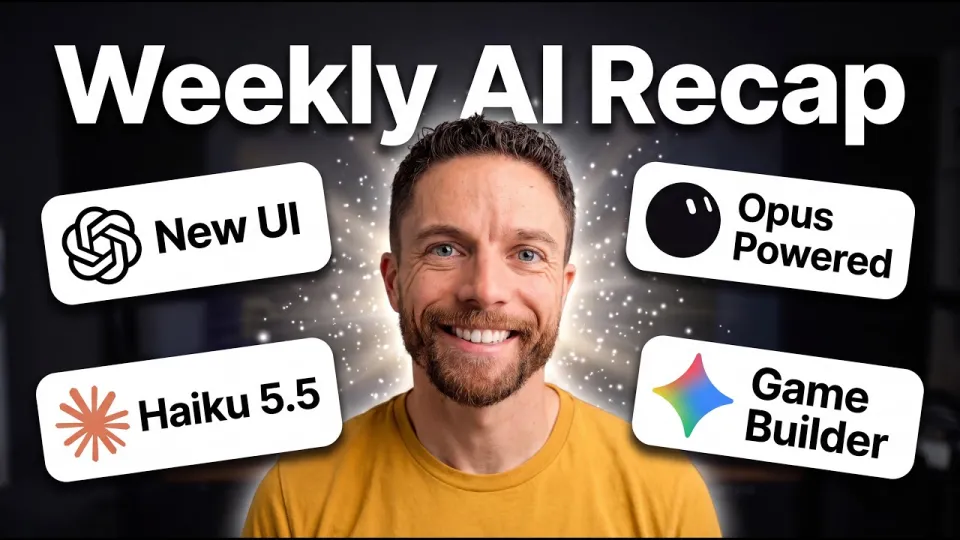
Video: Weekly AI Recap: GrokBot Just Did the Unthinkable, ChatGPT Looks Completely Different & More!
Need articles like this for your video? They help promote it on YouTube and Google — order them in the Telegram bot @sat_sit_bot. It writes articles around your video, embeds the video and publishes them on popular niche websites (no ads). Your first 50 articles are free.
· based on the channel Paul J Lipsky
Key takeaways
- Grok Bot is reportedly being positioned to draw on Claude, Midjourney and Suno rather than relying on a single model.
- ChatGPT gets a redesigned Intelligent UI that changes how users start tasks and pick tools.
- Claude Cowork moves to the cloud, letting Anthropic's agent-style workspace run beyond the local desktop.
- Google is adjusting Gemini subscription tiers and ships Nano Banana 2.1 for image generation.
- Paul J Lipsky's weekly recap tests Google Playground and flags open questions about bot permissions.
The latest AI news is dominated by three shifts: Grok Bot is being set up to call on Claude, Midjourney and Suno instead of one model, ChatGPT is rolling out a redesigned Intelligent UI, and Claude Cowork is moving from the desktop to the cloud. Google, meanwhile, is reshuffling Gemini plans and shipping Nano Banana 2.1. Paul J Lipsky's weekly recap pulls these threads together, and viewers who want to try the sponsor's agent workspace can register through Okou.
What changed in AI this week across Grok Bot, ChatGPT and Claude
Three product stories define the week, and each one points in the same direction: assistants are becoming orchestrators that route work to other tools rather than single chat windows. Grok Bot's reported plan to use Claude, Midjourney and Suno is the clearest example of model-agnostic design. ChatGPT's Intelligent UI is the interface side of the same idea, surfacing the right tool for the task instead of making users hunt for it. Claude Cowork's cloud move is the infrastructure side, taking an agent workspace that started close to the user's machine and making it reachable from anywhere.
Grok Bot's plan to use Claude, Midjourney and Suno
Grok Bot is the week's headline because it suggests a bot that delegates instead of doing everything itself. According to the recap, the assistant is being lined up to call on Claude for some reasoning tasks, Midjourney for images and Suno for audio. That is a notable departure from the usual pattern, where a chatbot is tied to one company's models and one company's output style.
What this means in practice:
- Users could get competitive output from several vendors inside one workflow, without switching tabs or subscriptions.
- Routing decisions become the product. The hard part is not generating an image or a paragraph; it is deciding which engine handles which request.
- Permissions and cost control matter more. A bot that can call paid third-party services needs clear limits on what it may spend and touch.
- Reliability depends on partners. If an external model changes its API or pricing, the bot's behaviour changes with it.
A viewer described handing a Grok Bot a link to a folder of business videos, giving instructions for a social media clip, receiving a voice script, recording it and getting back a result better than paid work. That is the promise of an orchestrating bot: one instruction, several tools, a finished asset. It is also the reason governance questions arrive quickly.
ChatGPT's Intelligent UI and what a redesign actually changes
ChatGPT's new Intelligent UI is a rethinking of the entry point rather than a new model. The recap frames it as a visibly different ChatGPT, with the interface adapting to what the user is trying to do instead of presenting the same blank prompt box for every task. For casual users the change is cosmetic; for daily users it changes how work starts.
Three practical effects are worth watching:
- Tool discovery. Features that used to be buried in menus become suggestions tied to the task at hand.
- Fewer dead ends. A prompt that needs an image, a file or a search can be routed before the user types a long workaround.
- New habits. Anyone with saved prompts and muscle memory will need a few days to relearn where things live.
Interface changes are easy to dismiss, but they decide which capabilities people actually use. A model that can generate images is useless to someone who never finds the button.
Claude Cowork moves to the cloud
Claude Cowork is Anthropic's agent-style workspace, and its move to the cloud removes the biggest practical constraint on it. Running locally ties an assistant to one machine, one operating system and one set of files. A cloud version can persist tasks, work across devices and keep a session alive after a laptop closes.
The trade-off is the same one every agent product faces. Cloud execution is convenient, but it asks users to trust a remote process with files, accounts and instructions. Teams evaluating Cowork should decide up front which folders and services an agent may reach, and log what it does. The recap also touches on Claude Haiku 5.5 in the Anthropic segment, a reminder that the model layer and the workspace layer are moving at different speeds.
Google's Gemini plan changes, Playground and Nano Banana 2.1
Google's segment covers three separate things that are easy to conflate. Gemini subscription plans are being adjusted, which matters to anyone budgeting for AI tools. Google Playground gets a hands-on test in the video, the kind of first-look that shows whether a demo survives real prompts. And Nano Banana 2.1 continues the image-generation line that has become one of Google's most visible consumer AI products.
One viewer raised a detail worth flagging: certain Google AI Plus tiers bundle a Pro-level model along with 2TB of storage, a combination that is easy to miss when comparing plan names alone. Plan comparisons should always check which model, how much storage and what usage limits are included, not just the tier label.
Questions viewers keep asking about AI agents
The comments around the recap reveal a consistent set of concerns, and they are more practical than theoretical. People are not asking whether agents work; they are asking how to use them safely and how to learn them without a technical background.
- What is this new bot in my account? One viewer deleted a primary Grok Bot because it appeared without explanation and looked like another bot going rogue. Unfamiliar agents should be identified in the product, not discovered by accident.
- Can a bot really replace paid creative work? The video-folder example suggests yes for some tasks, but the user still recorded the voiceover and judged the output. Human review remains part of the loop.
- How do non-technical people learn agent tooling? The most-liked request in the comments was a Claude Code tutorial for non-tech users, which signals demand for guided, step-by-step onboarding rather than documentation.
- Why do recap formats work? Viewers repeatedly say a weekly rundown is the only way they keep up, which is a fair summary of how fast release notes now arrive.
What the week signals about the direction of AI
The through-line is delegation. Grok Bot outsourcing to Claude, Midjourney and Suno, ChatGPT surfacing tools through its interface, and Claude Cowork moving to the cloud all describe the same architecture: a front end that decides, and a set of services that execute. For users, the skill that matters is specifying tasks clearly and setting boundaries. For vendors, the differentiator is routing quality and trust.
Bottom line
The week's AI news is less about a single breakthrough than about products learning to cooperate. Grok Bot's multi-model plan, ChatGPT's Intelligent UI and Claude Cowork's cloud move all push assistants toward orchestration, while Google's Gemini plan changes and Nano Banana 2.1 keep the consumer side competitive. Paul J Lipsky's weekly recap is a useful way to track this without reading every changelog, and his channel is the place to follow the follow-ups. If you want to test an agent workspace yourself, you can start with Okou's registration page.
Questions & answers
Is Grok Bot actually using Claude, Midjourney and Suno?
The weekly recap describes plans for Grok Bot to draw on those external services rather than a confirmed, fully shipped integration. Treat it as a stated direction and check the product itself for which models and tools are live in your account.
What is different about ChatGPT's Intelligent UI?
It is a redesign of how ChatGPT presents tools and starting points, adapting the interface to the task instead of showing one generic prompt box. The underlying models are not the story here; discoverability and task routing are.
What does Claude Cowork in the cloud change for teams?
Cloud execution lets an agent workspace persist across devices and keep working after a laptop closes. The trade-off is that teams must decide which files and services the agent can access and keep a record of what it does.
Should I upgrade my Gemini plan for the bundled Pro model and storage?
Compare the model access, storage allowance and usage limits rather than the tier name, since bundles differ. Some Google AI Plus tiers pair a Pro-level model with 2TB of storage, a detail that is easy to overlook in a quick comparison.
Source: Weekly AI Recap: GrokBot Just Did the Unthinkable, ChatGPT Looks Completely Different & More! · Markdown version